Why Participate in the SOF IMO?
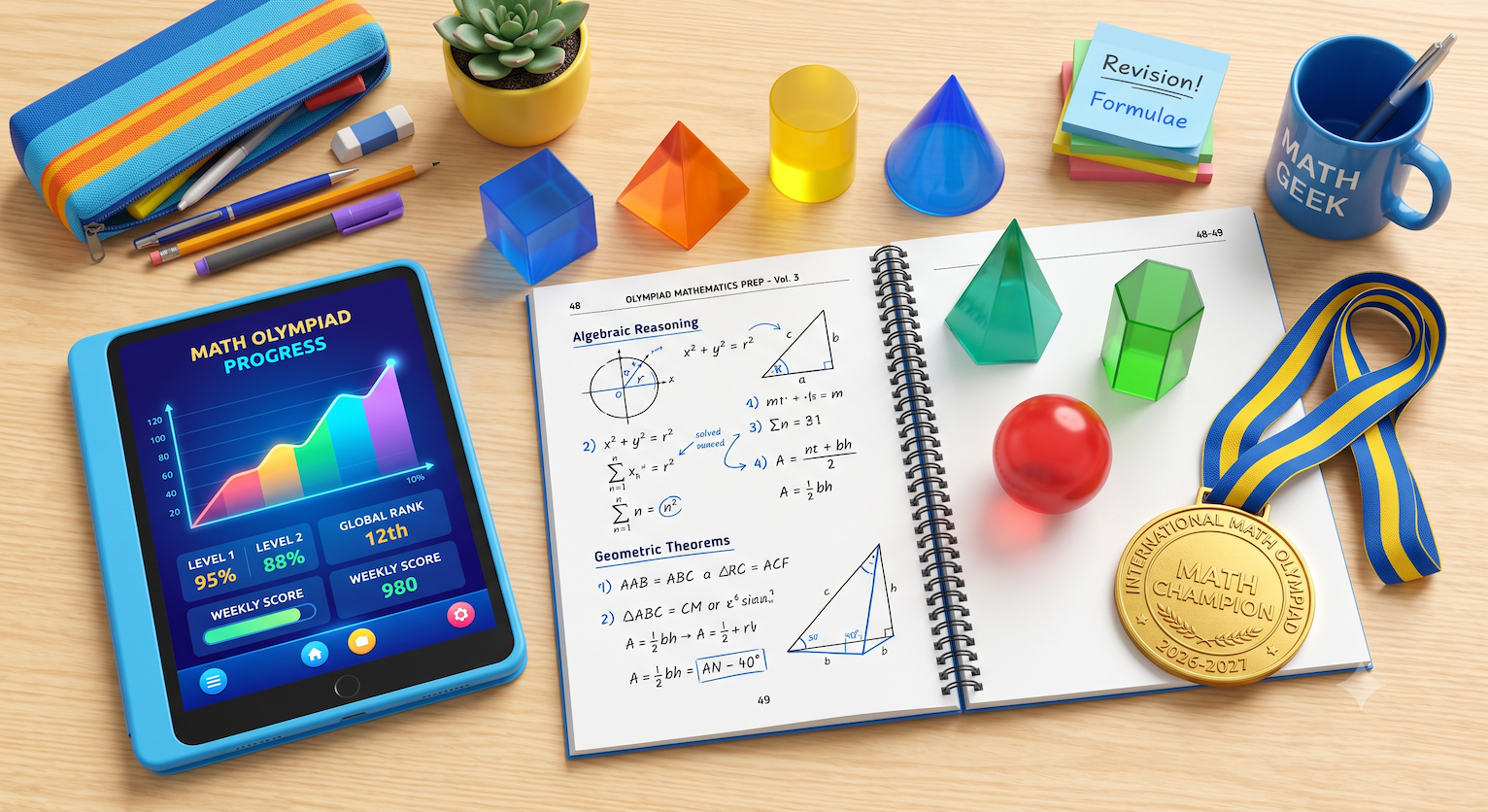
Participating in the IMO provides benefits that extend far beyond regular school tests:
- Builds a Strong Foundation: Encourages conceptual mastery over rote memorization, teaching students how formulas are derived and applied.
- Develops Logical Reasoning: Rigorously challenges spatial reasoning, pattern recognition, and critical thinking.
- Multi-Level Benchmarking: Provides an accurate assessment of a student’s standing across four competitive tiers: school level, regional level, national level, and international level.
- Early Competitive Exposure: Eliminates exam anxiety early, equipping students with test-taking endurance for future competitive exams like JEE, NEET, and the SAT.
The Two-Level Exam Structure
The IMO is structured into two competitive tiers to test fundamental grasp and advanced problem-solving:
- Level 1: Conducted in an offline mode within the student's own registered school. It is open to all students from Classes 1 to 12.
- Level 2: The advanced, high-stakes competition open exclusively to Classes 3 to 12. Qualification requires meeting one of the following criteria:
- Rank in the top 5% of participating students internationally in your class.
- Rank among the top 25 rank holders in your zone/region.
- Secure Class 1 rank in your school (provided at least 10 students appeared from the class and scored a minimum of 50%).
Exam Pattern & Marking Scheme
The Level 1 exam consists of objective (Multiple Choice Questions) with a 60-minute duration. There is no negative marking, so students should ensure every question is attempted.
Classes 1 to 4 Exam Pattern
| Section | Number of Questions | Marks per Question | Total Marks |
|---|---|---|---|
| Logical Reasoning | 10 | 1 | 10 |
| Mathematical Reasoning | 10 | 1 | 10 |
| Everyday Mathematics | 10 | 1 | 10 |
| Achievers Section | 5 | 2 | 10 |
| Grand Total | 35 | 40 |
Classes 5 to 10 Exam Pattern
| Section | Number of Questions | Marks per Question | Total Marks |
|---|---|---|---|
| Logical Reasoning | 15 | 1 | 15 |
| Mathematical Reasoning | 20 | 1 | 20 |
| Everyday Mathematics | 10 | 1 | 10 |
| Achievers Section | 5 | 3 | 15 |
| Grand Total | 50 | 60 |
Official SOF IMO Sample Papers
Practicing with authentic papers is the best way to understand question weightage, structure, and pacing before the real test.
You can access and download the official question blueprints and test formats directly from the Science Olympiad Foundation portal:
- Download Official Papers: SOF IMO Sample Papers
Start Learning free
Class-Wise Syllabus & Fuuvix Focus Areas (Classes 4 to 7)
The SOF IMO syllabus adheres strictly to the National Education Policy (NEP), NCF, NCERT, and CBSE guidelines.
Class 4
- Logical Reasoning: Patterns, Alphabet Test, Coding-Decoding, Ranking Test, Mirror Images, Geometrical Shapes and Solids, Embedded Figures, Direction Sense Test, Possible Combinations, Analogy and Classification, Clock and Calendar.
- Mathematical Reasoning & Everyday Math: Numerals, Number Names, Number Sense (>4-digit numbers), Computation Operations, Fractions, Length, Weight, Capacity, Time, Money, Geometry, Perimeter of Various Shapes, Symmetry, Conversions, Data Handling.
Fuuvix Focus Area: Prioritize fractions, time and money arithmetic, and perimeter calculations. These questions dominate the Everyday Mathematics section and introduce real-world problem-solving.
Class 5
- Logical Reasoning: Patterns, Analogy, Classification, Geometrical Shapes, Mirror and Water Images, Direction Sense Test, Ranking Test, Alphabet Test, Logical Sequence of Words, Puzzle Test, Coding-Decoding, Clock and Calendar.
- Mathematical Reasoning & Everyday Math: Numerals, Number Names, Number Sense (7 and 8-digit numbers), Computation Operations, Fractions and Decimals, Measurement of Length, Weight, Capacity, Time, Temperature, Money, Conversions, Angles, Perimeter of Various Shapes & Area of Rectangle and Square, Symmetry, Data Handling.
Fuuvix Focus Area: Focus heavily on Angles, Factors and Multiples, Fractions, Decimals, and Area calculations. Multi-step unit conversions inside perimeter/area word problems are primary traps in the Achievers Section.
Class 6
- Logical Reasoning: Verbal and Non-Verbal Reasoning patterns.
- Mathematical Reasoning & Everyday Math: Patterns in Mathematics, Lines and Angles, Number Play, Data Handling and Presentation, Prime Time, Perimeter and Area, Fractions, Playing with Constructions, Symmetry, The Other Side of Zero.
Fuuvix Focus Area: Master The Other Side of Zero (Integers), Prime Time (Factors and Multiples), and Number Play. These topics are completely new to 6th graders and require repeated conceptual drills.
Class 7
- Logical Reasoning: Advanced Verbal and Non-Verbal Reasoning.
- Mathematical Reasoning & Everyday Math: Large Numbers Around Us, Arithmetic Expressions, Expressions using Letter-Numbers, Lines and Angles, Number Play, Triangles, Congruence of Triangles, Fractions, Decimals, Integers, Factors and Multiples, Data Handling, Constructions and Tilings, Simple Equations.
Fuuvix Focus Area: Target Expressions using Letter-Numbers (Algebra), Simple Equations, and Triangles & Congruence. The Achievers Section routinely blends algebraic expressions with geometric formulas to test multi-layered problem solving.
The Evolution of Common Focus Areas (Class 4 to 7)
Mathematics is progressive. Rather than memorizing isolated chapters, students must understand how core mathematical concepts develop in depth and abstraction year after year.
Class 4: Concrete Basics ──► Class 5: Rules & Classifications ──► Class 6: Abstract Systems ──► Class 7: Algebraic Applications
1. Angles: From Corner Recognition to Geometric Proofs
- Class 4 (Visual Foundation): Identifying vertices, corners, and recognizing shapes with right angles.
- Class 5 (Formal Classification): Using protractors to measure degrees and classifying angle types: Acute, Right, Obtuse, Straight, and Reflex angles.
- Class 6 (Line Intersections): Calculating relationships between adjacent angles, vertically opposite angles, and properties of intersecting lines.
- Class 7 (Advanced Geometry): Complex multi-step reasoning involving parallel lines intersected by transversals (alternate interior, corresponding angles) and angle properties in triangle congruence.
2. Fractions & Decimals: From Parts to Rational Systems
- Class 4 (Visual Parts): Shaded region fractions, proper/improper fractions, and basic equivalent fractions.
- Class 5 (Operations & Decimals): Adding and subtracting unlike fractions, comparing mixed fractions, and linking fractions directly to decimal notation.
- Class 6 (Algorithmic Fluency): Reciprocals, fraction multiplication, long division with decimals, and recurring decimal conversions.
- Class 7 (Rational Numbers): Transitioning fractions and decimals into formal Rational Numbers, solving complex fractional equations within real-world scenarios.
3. Factors and Multiples: From Times Tables to Number Theory
- Class 4 (Multiplication Basics): Identifying multiples, skip-counting patterns, and finding common factors.
- Class 5 (LCM & HCF Foundations): Systematic division and prime tree methods to calculate Least Common Multiple (LCM) and Highest Common Factor (HCF).
- Class 6 (Prime Time): Advanced prime factorization, discovering twin primes, co-primes, and applying divisibility rules (for 3, 6, 7, 8, 9, and 11).
- Class 7 (Applied Word Problems): Olympiad-tier word problems involving LCM/HCF (e.g., synchronized bell chimes, circular track intervals, and tile-paving dimensions).
4. Integers: Crossing "The Other Side of Zero"
- Class 4 & 5 (Positive Domain): Calculations restricted to whole numbers, positive scales, and numbers up to 8 digits.
- Class 6 (The Negative Line): Formal introduction to directed numbers—representing profits/losses, temperatures below freezing, and adding/subtracting on the number line.
- Class 7 (Nested Integer Arithmetic): Handling order of operations (BODMAS) with positive and negative signs, evaluating brackets within multi-layered arithmetic expressions.
5. Data Handling: From Pictographs to Statistical Analysis
- Class 4 (Pictorial Data): Reading scaled pictographs and simple single-bar charts.
- Class 5 (Tabulation & Comparison): Recording tally charts, frequency tables, and comparing datasets using bar graphs.
- Class 6 (Organization & Range): Organizing large raw datasets, finding the data range, and constructing precise bar plots.
- Class 7 (Central Tendency & Probability): Introduction to Statistics, Calculating Mean, Median, detecting Outliers from grouped data and and comparing datasets using dot plots, bar graphs and double bar plots.
Official SOF IMO Course Material & Books
To build an exam-ready foundation, study materials should be sourced directly from the Science Olympiad Foundation and its publishing partner, MTG Learning Media:
- SOF IMO Workbooks: Class-specific practice workbooks mapped directly to the Olympiad question style.
- SOF Reasoning Workbooks: Essential practice for the 10 to 15 marks dedicated strictly to pattern recognition, series, and spatial reasoning.
Supercharge Your Preparation with Fuuvix
While workbooks provide question banks, students need an intelligent study workflow that targets weaknesses, tracks accuracy, and builds daily retention. Fuuvix is engineered specifically around the SOF curriculum (IMO, NSO, and ISO) through four dedicated learning pillars:
Pillar 1: Concept Mastery Engine (Learn)
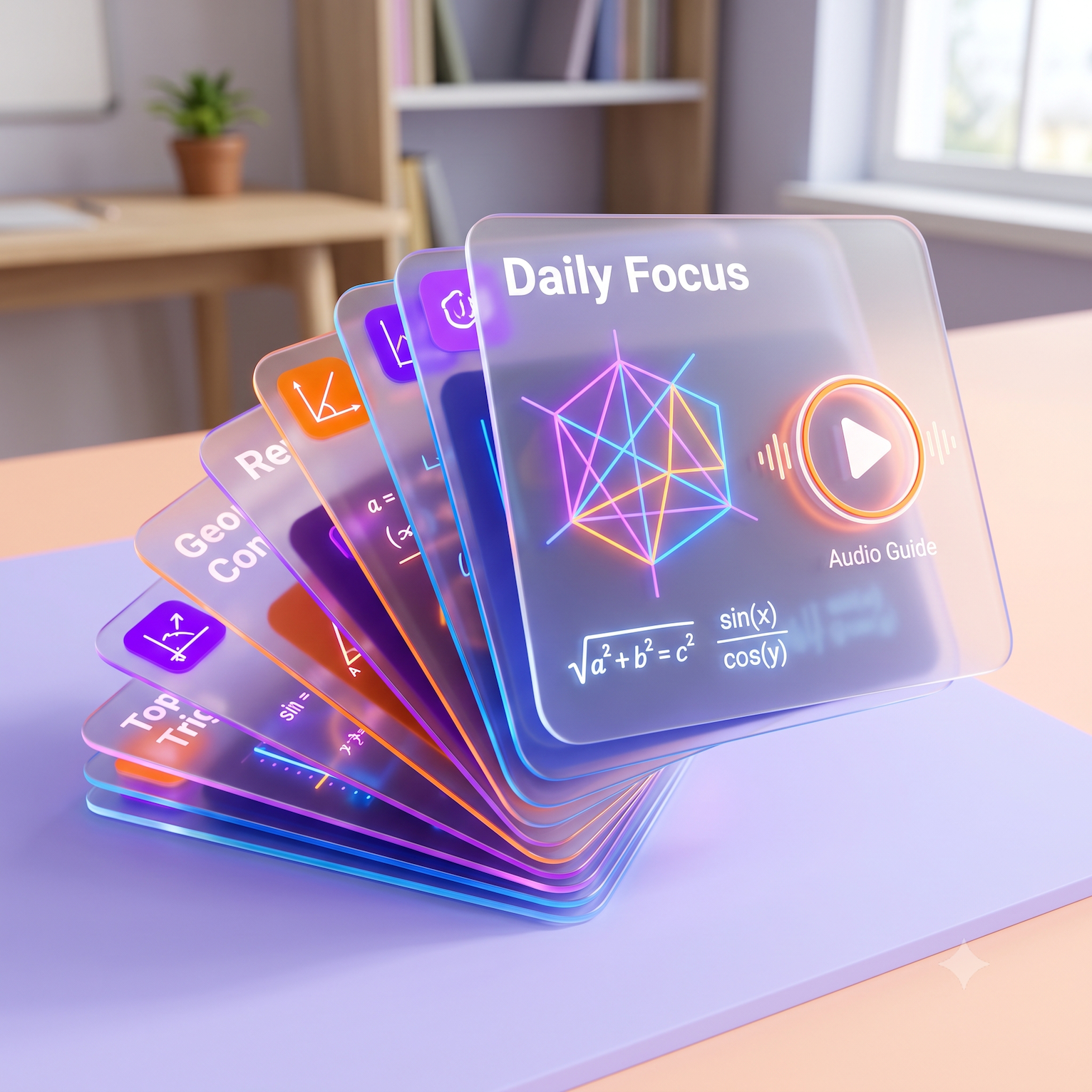
Instead of wading through dense textbooks, students learn through Visual Learning Cards—crisp, illustrated modules that break complex math into visual memory cues, formulas, and common exam traps. Integrated audio voiceovers enable multi-sensory retention, while short video lessons unpack high-difficulty problems. A single Daily Focus module removes decision fatigue by giving students a clear starting point every morning.
Pillar 2: Goal-Driven Practice Engine (Practice & Quiz)

Unstructured question-solving wastes time. Fuuvix organizes chapter banks into Easy, Medium, and Hard tiers, allowing students to pick an intentional study goal before starting:
- Fresh Questions: Solves only unattempted problems to systematically cover the syllabus.
- Fix Mistakes: Surfaces previously missed problems for immediate correction.
- Starred Questions: Lets students revisit problems they flagged as tricky during earlier practice.
- Mixed Set: Combines seen and unseen questions to test active recall.
- Olympiad Set: Pulls higher-order thinking (HOTS) questions calibrated for the high-scoring Achievers Section.
- Interleaved Daily Quiz: A rapid 10-question mixed drill across all unlocked chapters to maintain cross-topic retention.
Pillar 3: The Revision Stations (Targeted Mistake Engine)
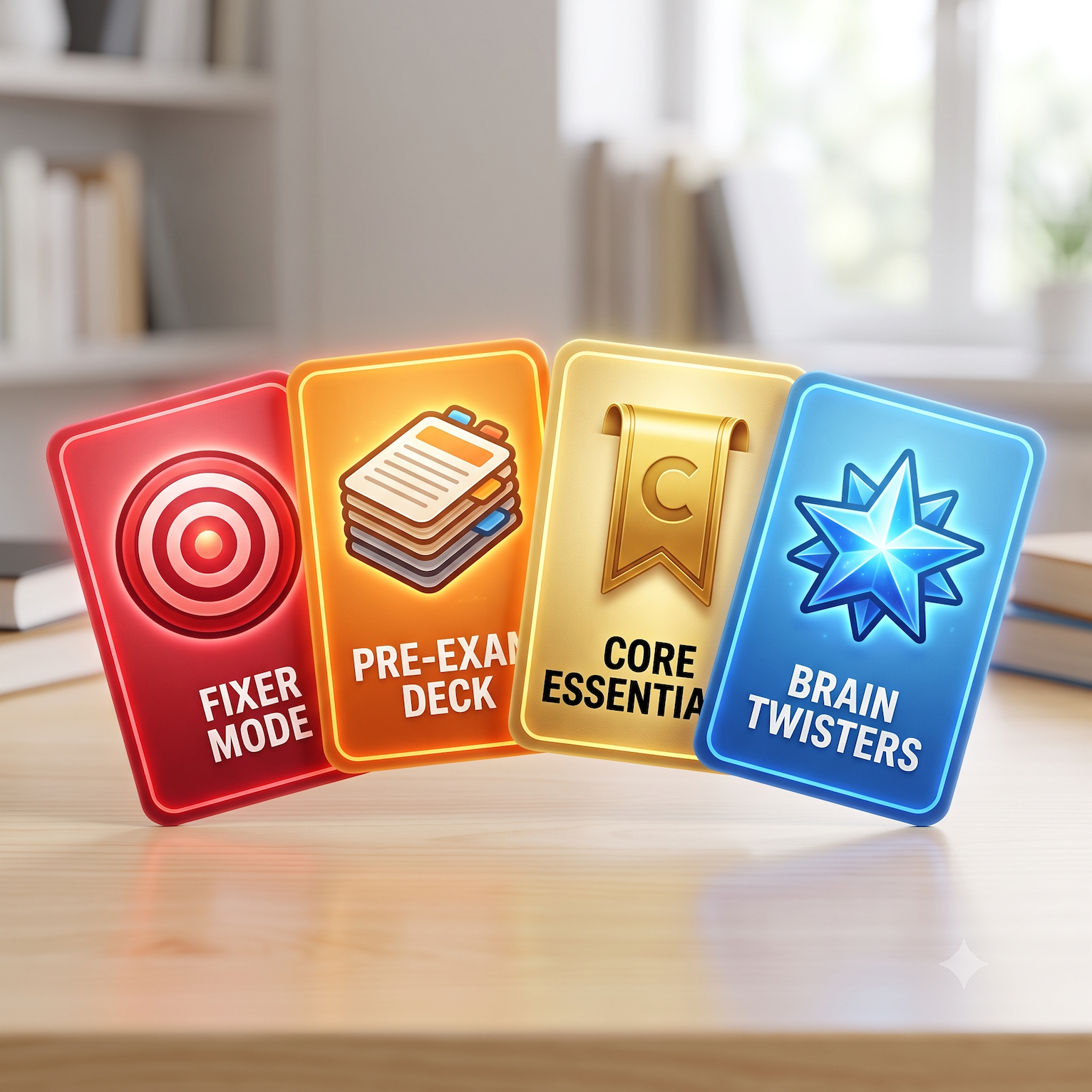
The difference between qualifying for Level 2 and missing out comes down to eliminating repeat errors. The Fuuvix Revision Stations feature four distinct remediation tools:
- Fixer Mode: An automated remediation engine that logs every question answered incorrectly during practice or quizzes, queuing it for mandatory re-attempts until mastered.
- Pre-Exam Deck: A curated deck of personal flashcards designed for rapid review right before exam day.
- Core Essentials: A student-curated bookmark repository for essential rules, properties, and definitions.
- Brain Twisters: A personal vault where students can star complex, multi-concept problems with one click, creating a custom challenge set for weekend review.
Pillar 4: Learning Pulse Diagnostics
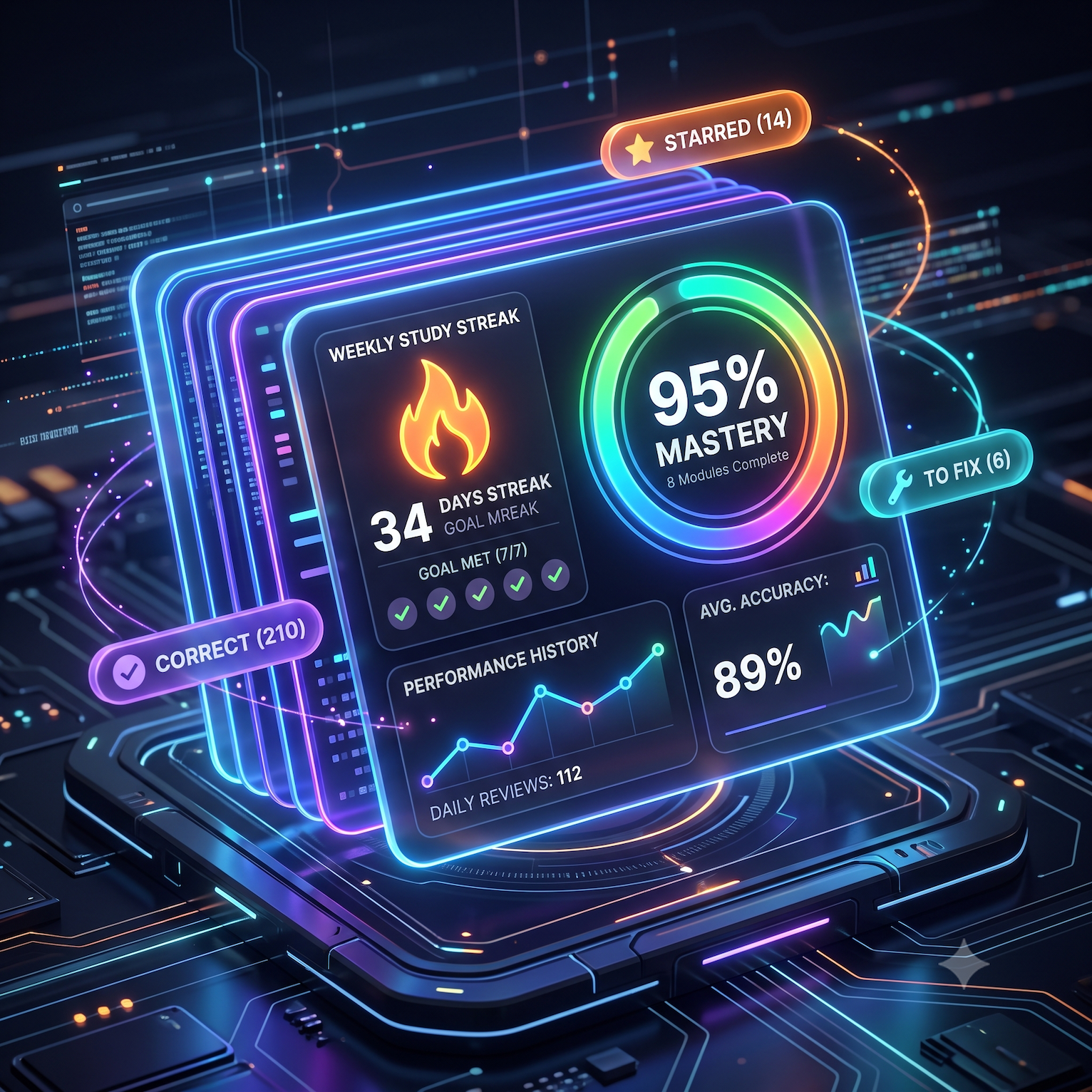
Stay fully informed about preparation depth without guessing. The Learning Pulse dashboard categorizes chapter progress into real-time metrics:
- Granular Question Tracking: Instant counts of questions categorized into Correct, To fix, Unattempted, and Starred.
- Syllabus Mastery Indicators: Real-time visibility into overall syllabus coverage (e.g., 95% syllabus completed) and topic accuracy.
- Habit Tracking: Daily study streaks with flame indicators and target rings to ensure consistent study routines leading up to exam day.
Start preparing early, build consistent daily study habits, and pair official SOF resources with the diagnostic power of Fuuvix to master the SOF IMO 2026-2027!