
Why this section feels unfair
Your child knows the science chapter. They can name the parts of a flower and explain evaporation. Then the olympiad paper opens, and the first section asks which figure comes next in a row of rotating arrows.
Nothing in the school year prepared them for that, and it is not their fault. The reasoning section does not test what they have learned. It tests whether they can spot a rule they have never been shown, in under a minute, from four or five examples.
That is a skill, which means it can be practiced. It just cannot be revised.
The question types your child will actually meet
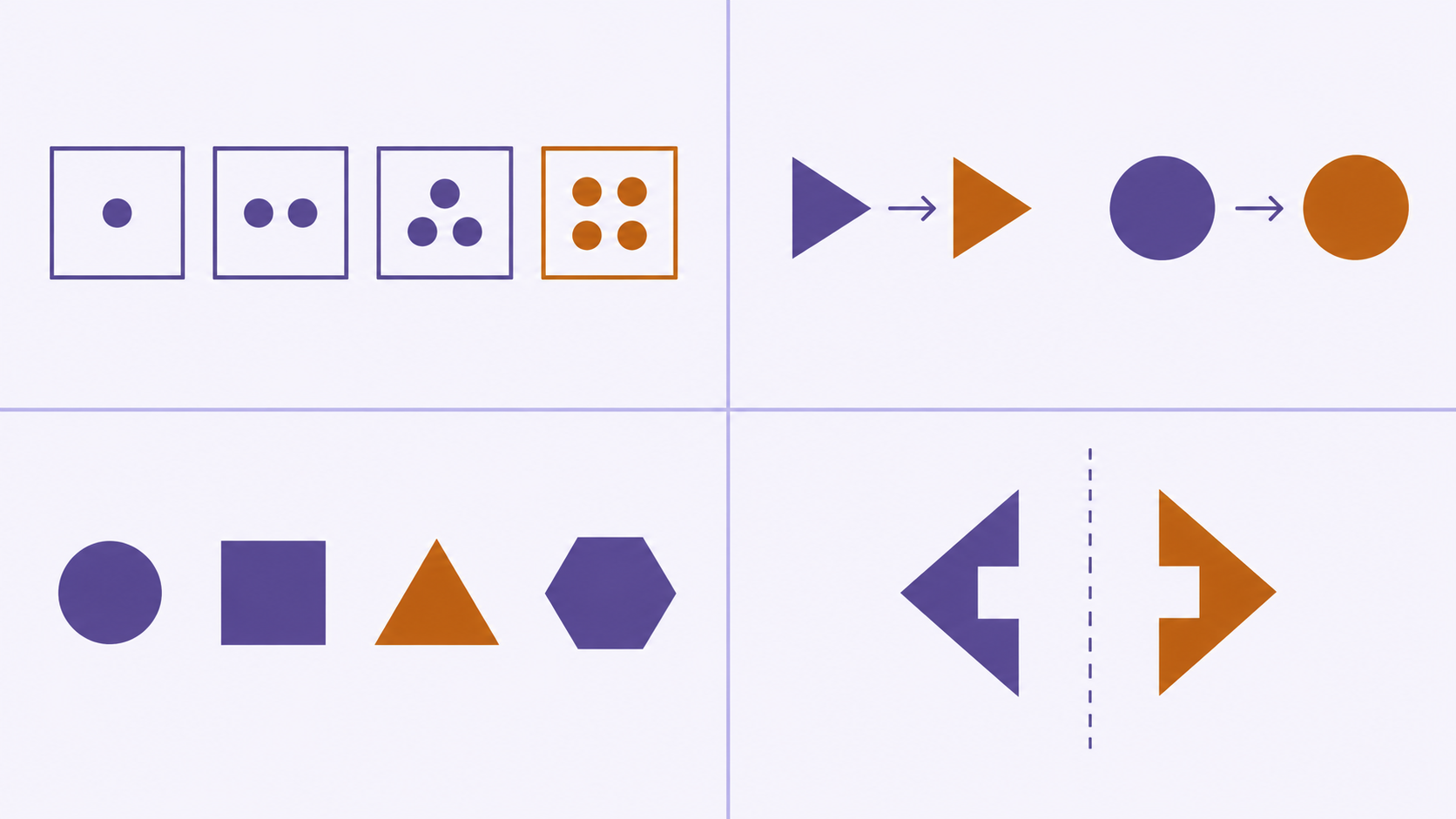
Almost everything in this section is one of a handful of families. Once a child can name the family, the question stops being a surprise.
Series completion
A row of numbers or shapes, with the last one missing.
2, 5, 11, 23, ?
The trap is to look for one operation. The differences here are 3, 6 and 12, and each is double the one before, so the next gap is 24 and the answer is 47.
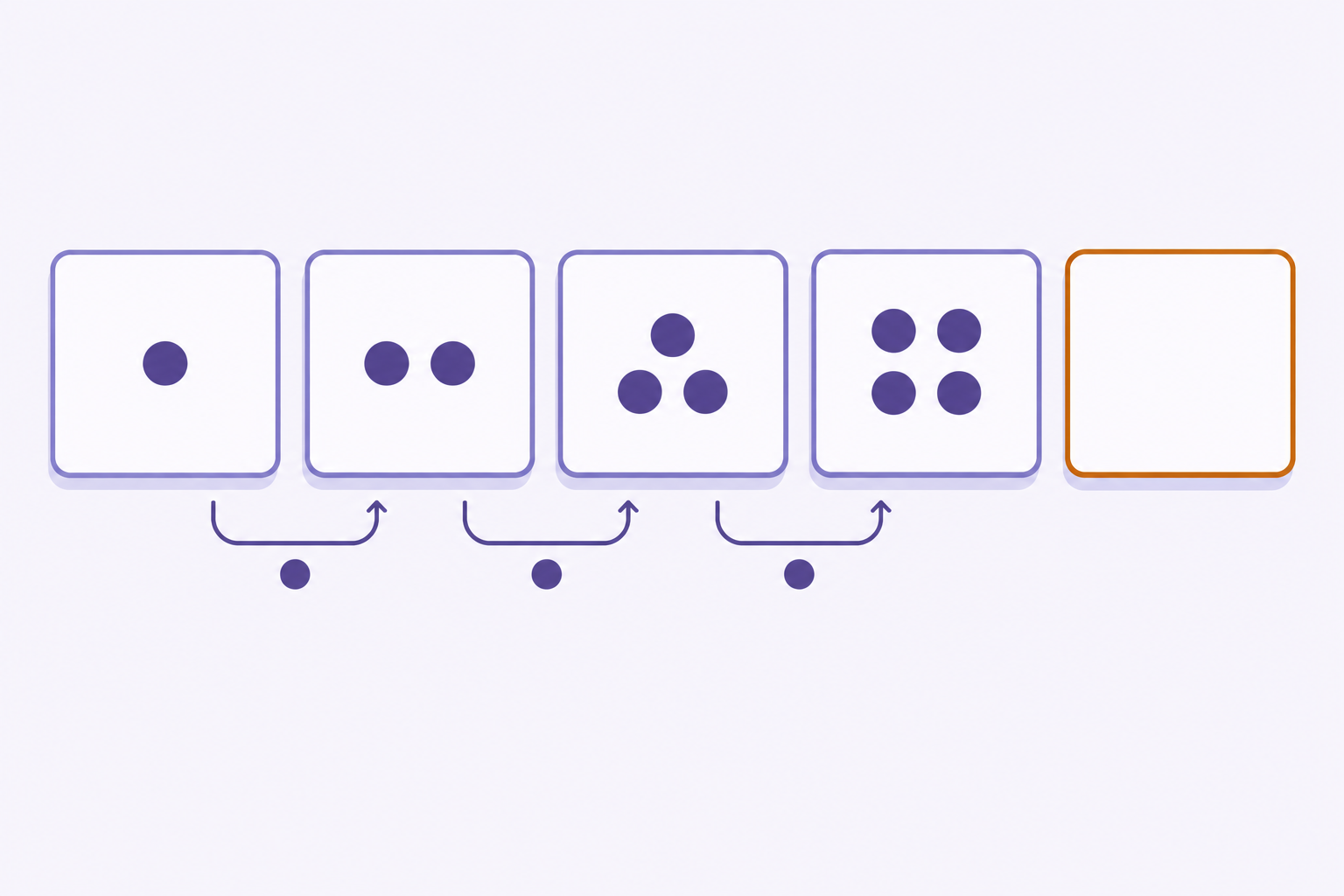
Shape series work the same way, except the rule lives in rotation, count or shading instead of value. The habit to build is identical: look at the gaps between the terms, not the terms.
Analogy
Two things related in a particular way, then a third looking for its partner.
Circle is to sphere as square is to ?
The answer is cube, because the relationship is flat shape to solid shape. Children lose these by answering the category instead of the relationship — picking rectangle, because it is also a shape.
Odd one out
Four or five items, one of which does not belong.
9, 16, 25, 30, 36
Every number here is a perfect square except 30. Say the shared property out loud before choosing, or you end up hunting for a reason to exclude the number you happened to notice.
Coding and decoding
A word is written in a code, and a second word has to be coded the same way.
If CAT is written as DBU, how is DOG written?
Each letter has moved one step forward in the alphabet, so DOG becomes EPH. These are quick marks once a child knows to check the alphabet distance first.
Direction sense
A short journey, then a question about where you ended up.
Walk 3 km north, turn right, walk 4 km. How far are you from where you started?
Drawing it is the whole trick. Three up and four across gives a right-angled triangle, so the distance is 5 km — and you are north-east of where you began.
Ranking
Positions in a row or a queue.
In a line of 20 children, Anya is 7th from the left. What is her position from the right?
Twenty minus seven, plus one, is fourteen. The plus one catches almost everyone the first time, because Anya has to be counted once herself.
Mirror images, water images and embedded figures
The visual family. A shape is reflected across a vertical line, or a smaller shape is hidden inside a busy one and has to be found.
These reward practice more than reasoning, because the eye gets faster with exposure. A child who has seen twenty embedded-figure questions solves the twenty-first in seconds; a child seeing their first will stare at it for two minutes.
Three mistakes that cost the most marks
Reading the rule off the first two terms. Given 2, 4, a child decides "doubling" and commits. But 2, 4, 6 and 2, 4, 8 both start that way. A rule is not a rule until it survives the third term.
Forcing a rule that fits some of the options. If the pattern only explains three of the five items, it is the wrong pattern. This is worth saying out loud to a child, because a nearly-working rule feels like success.
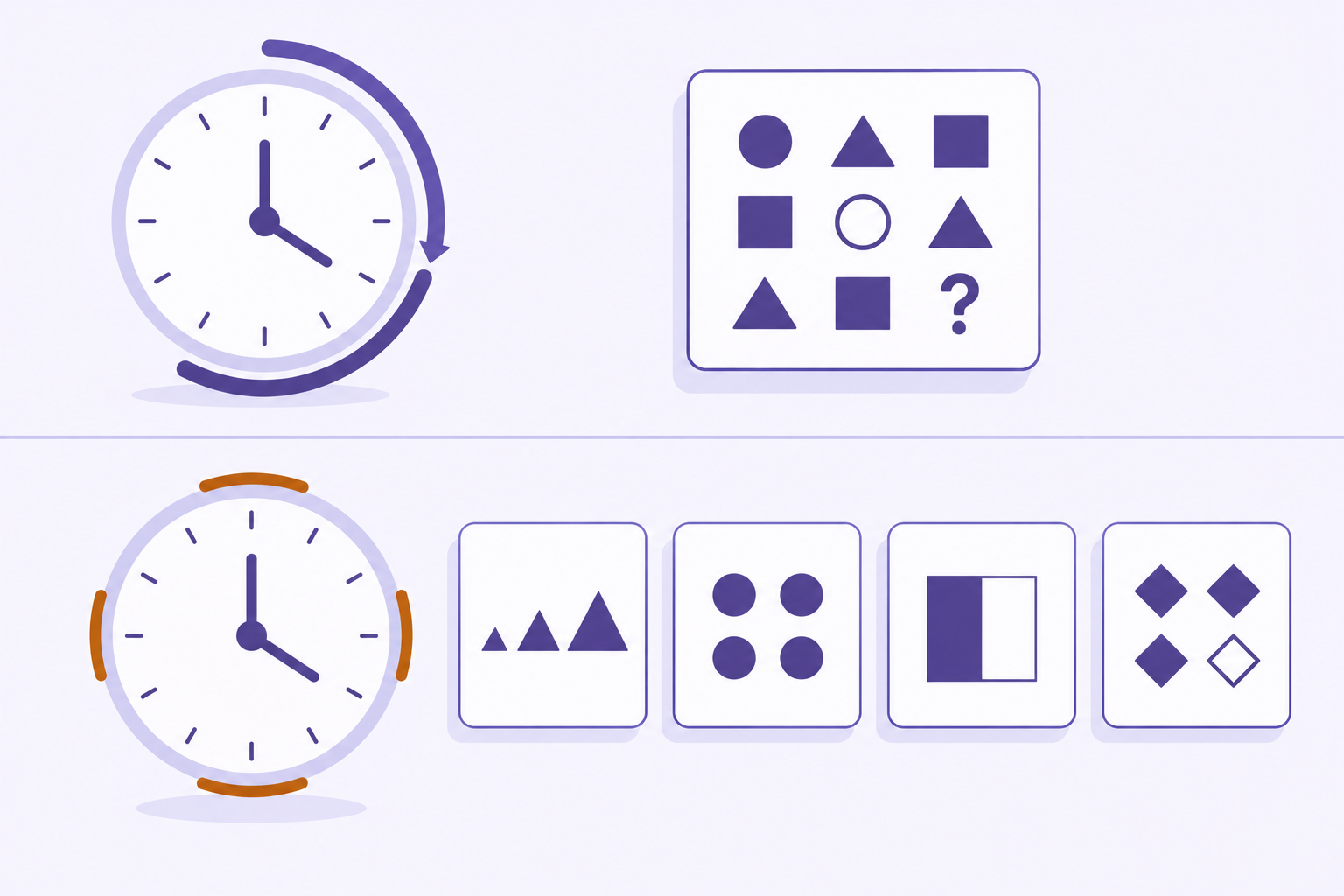
Spending five minutes on one stubborn figure. Time is the scarce thing in this section. Minutes poured into a question that refuses to open are minutes taken from questions that would have opened immediately. Mark it, move on, come back if there is time.
How to practice it, in a way that works
Reasoning does not improve by reading about reasoning. It improves in short, frequent, mixed sets — which is exactly what the research on retrieval practice predicts, and we wrote about that in active recall versus re-reading.
Three habits, in order of how much they help:
- Name the rule before choosing the answer. Saying "each shape gains one side" out loud forces the pattern to be explicit. A child who cannot say the rule is guessing, even when the guess is right.
- Mix the families. Ten series questions in a row train recognition of series. Ten mixed questions train the thing the paper actually asks for, which is working out which family you are looking at.
- Keep sets short. Ten to fifteen minutes of full attention beats an hour of drifting. Reasoning collapses when a child is tired, faster than recall does.
And when a question is wrong, do not just read the correct answer. Ask what rule the paper intended, and where the eye went instead. That second question is where the improvement lives — the same point we make in why students forget what they study.
Practice this free on Fuuvix
Fuuvix covers Maths and Science for Classes 4 to 7 as short visual topic cards with a quiz on every topic, and the daily quiz mixes question types deliberately so the recognition habit gets built rather than assumed.
The pattern topics are the closest thing on Fuuvix to this section of the paper, and they are in the free chapters:
- Number patterns — the series questions above, taught as a rule to name rather than a gap to guess.
- Repeating patterns and letter and word patterns — the shape and coding families, from the other direction.
- Then attempt them under time in Maths practice, or work through the full Class 4 Maths topics if the basics need shoring up first.
The first two chapters of every subject are free, so a child can attempt real questions today without an account decision.
One last thing worth telling your child: the reasoning section is the one part of the paper where everyone starts from roughly the same place. School does not teach it to anybody. That makes it the fastest section to gain on.